What Is SEO? A Beginner’s Guide for Business Owners
What is SEO and why does it matter? Learn how search engines rank pages, the 3 core SEO pillars, and simple first steps to grow organic traffic for your business.
Most business owners know they “need SEO,” but ask them to explain what it actually is, and you’ll get a vague answer about Google, keywords, maybe something about a blog.
That gap between knowing you need it and knowing how it works is exactly where marketing budgets get wasted and months of effort go nowhere.
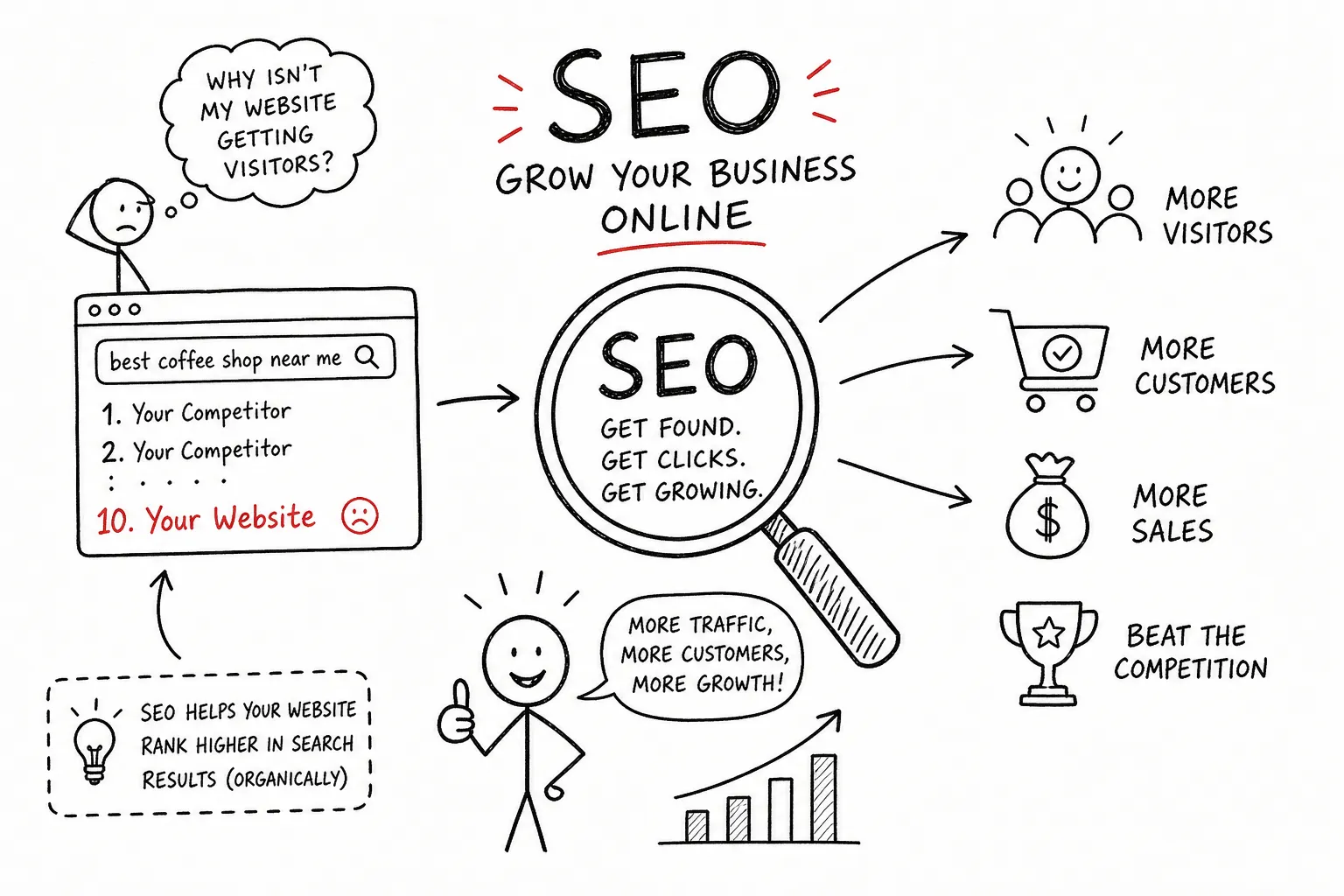
Search engine optimization is the process of making your website easier for search engines to find, understand, and trust, so it shows up when potential customers search for what you offer. It isn’t a single tactic you apply once. It’s a system of interconnected disciplines that work together over time, which is why specialist firms like DE SEO Consulting exist to manage that complexity while you stay focused on running your business.
This guide covers the essentials: how search engines decide rankings, the three core pillars every SEO strategy is built on, a realistic timeline for results, the mistakes that quietly stall progress, and where to start today.
How search engines actually find and rank your website
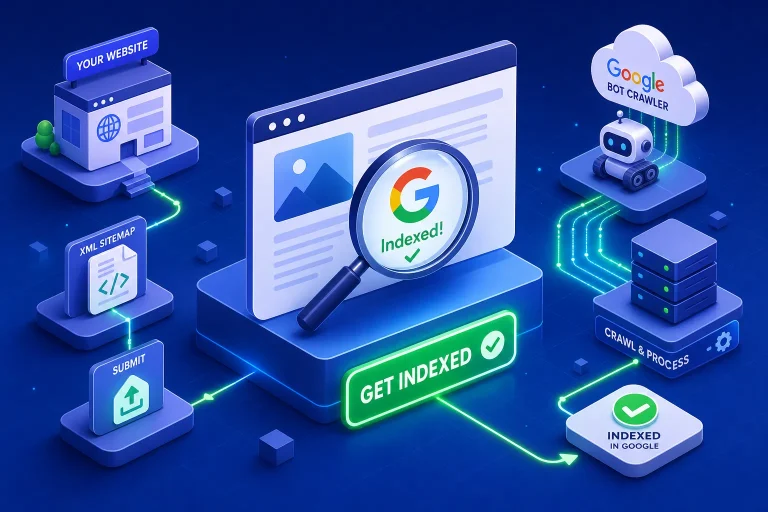
Search engines like Google and Bing use automated programs called crawlers (sometimes called spiders or bots) that continuously scan the web, following links from page to page to discover new and updated content. Think of Googlebot as a librarian walking every aisle of an infinite library, checking every shelf for new books and updated editions. Once a page is crawled, it gets added to the search engine’s index, which is essentially a massive digital catalogue of web content.
When someone types a search query, the engine pulls from that index and ranks pages based on hundreds of signals. This happens in milliseconds, but the work that determines where your page lands starts long before anyone searches for you.
If your site can’t be crawled, it doesn’t exist in search. If it’s indexed but irrelevant to what someone is searching for, it won’t rank. Both problems cost you real customers, and both are fixable once you understand what’s causing them.
What Google looks for when ranking pages in 2026
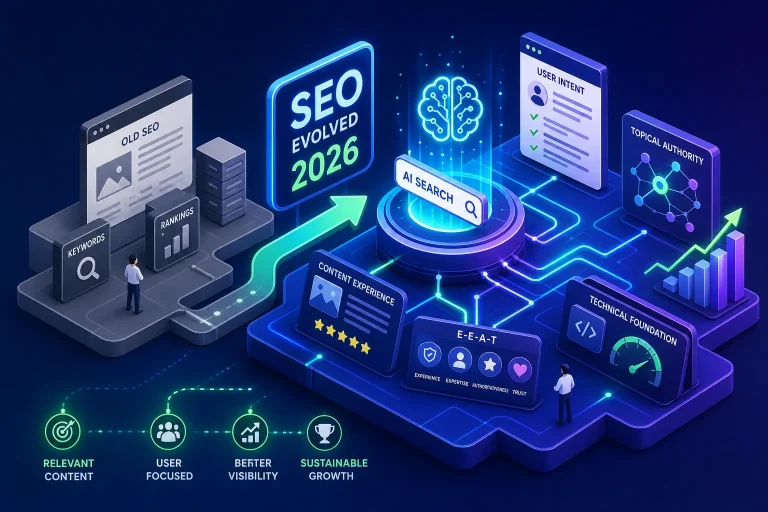
Google publicly emphasizes a handful of core signals. Search intent alignment is the most fundamental: your content needs to match the actual reason someone is searching, not just the words they typed. E-E-A-T (Experience, Expertise, Authoritativeness, and Trustworthiness) is Google’s framework for evaluating content quality, and it applies directly to how your site is written and structured. Core Web Vitals measure your site’s loading speed, interactivity, and visual stability, and mobile-first indexing means Google ranks based on how your site performs on a phone, not a desktop.
Beyond what Google officially confirms, industry analysts at Ahrefs and Backlinko consistently identify backlink quality and topical authority as strong ranking drivers. A site that covers a single subject in depth from multiple angles tends to outrank a site with scattered content across unrelated topics. Understanding these signals gives you a clear picture of where to focus your energy.
The three pillars every SEO strategy is built on
SEO isn’t one discipline; it’s three interconnected ones, and a weakness in any of them limits what the others can accomplish. Picture a physical storefront to understand how they relate: technical SEO is the building’s foundation and structure, keeping everything standing and accessible. On-page SEO is the signage, displays, and messaging on the page that tell customers exactly what you offer. Off-page SEO is the reputation your business has built in the surrounding community, the reason someone walks through the door in the first place.
On-page SEO: what your visitors and Google both see
On-page SEO covers everything visible on your website, starting with the content itself. This means writing clearly and specifically about what you offer, using relevant keywords naturally in your title tags, headers, and body text, and structuring pages so both humans and search engines can follow the logic immediately. Meta descriptions, URL structure, and internal links between related pages also fall under this category.
The goal of on-page SEO is to make your content genuinely useful and easy to understand. Pages that fully answer the question behind a search query consistently outperform pages that are thin, vague, or written primarily to tick keyword boxes.
Technical SEO: the invisible foundation
Technical SEO covers the elements that don’t show up in your published content but determine whether search engines can access and interpret your site at all. This includes site speed, mobile responsiveness, HTTPS security, XML sitemaps, and structured data (also called schema markup). If your pages load slowly, aren’t accessible on mobile, or return crawl errors, your rankings suffer regardless of how strong your content is.
Technical fixes are often the fastest-moving lever in SEO. Resolving crawl errors or compressing oversized images can show movement in a matter of weeks, while content and link-building efforts take longer to build momentum.
Off-page SEO: building trust beyond your website
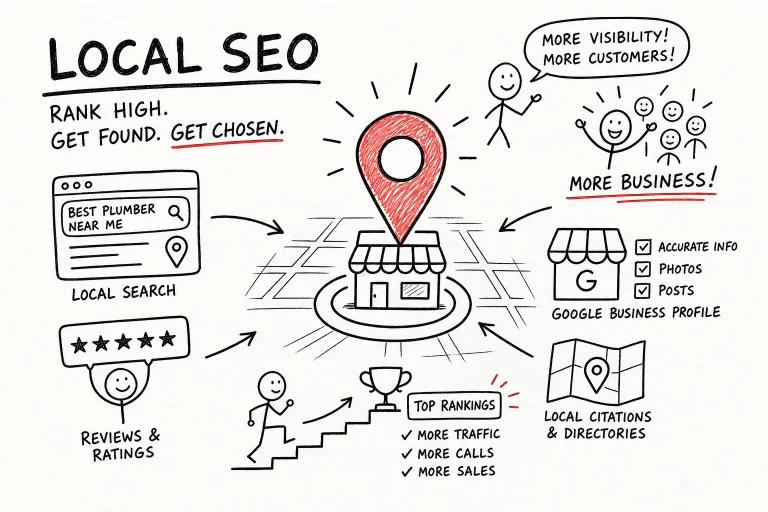
Off-page SEO covers everything that happens outside your own site. Backlinks from credible, relevant websites signal to Google that your content is trustworthy and worth referencing. Online reviews, brand mentions, and local citations contribute to the same picture. Google interprets these external signals as votes of confidence from the wider web, which is why a site with strong external authority regularly outranks equally good content from less established domains.
For local businesses especially, consistent citations across directories and a healthy review profile on Google are among the most direct paths to improved search visibility in a specific geographic area.
Why organic search visibility matters more than most owners realize
Paid ads stop the moment your budget runs out. Organic search traffic compounds: a well-ranked page keeps driving visitors for months or years without additional per-click spend. That’s the core strategic difference between renting attention through ads and earning it through SEO done right.
According to click-through-rate research from firms like Advanced Web Ranking and Sistrix, the top organic results consistently capture a disproportionate share of clicks for any given search query. A page that earns a strong ranking doesn’t just attract traffic once; it works continuously, making every hour of optimization effort more valuable over time than an equivalent ad budget spent on clicks that disappear when the campaign ends.
Organic visibility also drives more qualified visitors. People clicking organic results are actively searching for what you offer, not passively scrolling past an ad. For many businesses, that difference in intent shows up in conversion rates and cost per lead over time. Appearing in search results also builds brand credibility in a way a paid placement simply doesn’t: customers tend to trust what Google surfaces organically.
A realistic look at how long SEO takes to work
One of the most damaging myths about SEO is that it delivers fast results. Most small business websites start seeing measurable improvements in organic traffic between three and six months after implementing solid changes. Technical fixes can move the needle in a few weeks, but content authority and ranking stability take longer to develop. Businesses investing under $500 per month in SEO often see no significant movement before the nine-month mark.
Brand-new websites face an additional challenge: search engines need time to build trust in a new domain. For a site that has been live for under a year, the realistic window for meaningful, compounding results stretches to six to twelve months. Local businesses targeting specific geographic searches can sometimes see early traction within three to four months, particularly if they build citations, collect reviews, and publish content that directly addresses local search queries.
What to expect in the first 60-90 days
The first two weeks should focus on fixing crawl and indexing errors, the kind of foundational work that clears the path for everything that follows. These are typically quick wins: a misconfigured robots.txt file, a missing sitemap submission, pages returning errors that should be live.
From week three onward, the focus shifts to publishing keyword-targeted content that matches real search intent, while simultaneously building initial citations and connecting related pages through internal links. Think of this phase as laying groundwork rather than expecting traffic spikes. The results that matter come later, built on the work done now. Keep in mind this is an example plan; your exact timeline will depend on your site’s current state and competitive landscape.
Tools that cost nothing and work immediately
Start with the free stack before spending anything on paid platforms. Google Search Console shows you rank tracking, indexing errors, and click data directly from Google. Set this up before you publish a single page. Google Analytics 4 tracks traffic behaviour and source. Google Keyword Planner provides search volume estimates for keywords you’re considering (you’ll need a free Google Ads account to access it). Screaming Frog’s free tier crawls up to 500 pages and flags technical issues in minutes. Together, these four tools cover the core fundamentals for most beginners: indexing health, keyword research, traffic behaviour, and a basic technical audit. When you’re ready to scale, platforms like Semrush or Ahrefs offer deeper competitive and backlink analysis worth the investment.
Beginner mistakes that quietly stall your search rankings
Knowing what SEO is matters less than knowing what not to do when you’re starting out. The most costly errors aren’t obscure technical problems. They’re predictable mistakes, and once you know what to look for, they’re easy to avoid.
Content and keyword errors that are easy to avoid
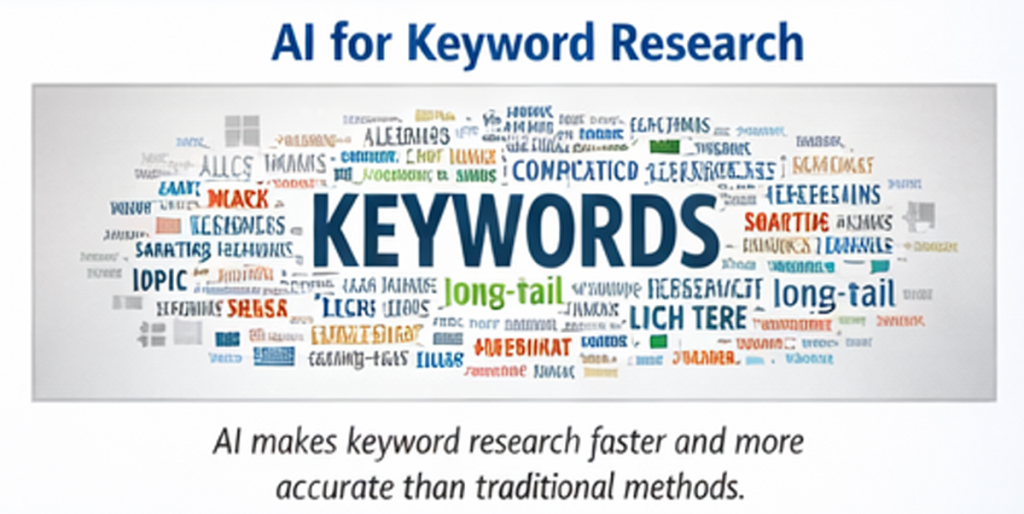
Keyword stuffing is one of the fastest ways to trigger ranking penalties. Overloading a page with repeated phrases makes content unreadable for humans and signals manipulation to search engines. The correction is straightforward: write for the reader first and use keywords naturally in titles, headers, and body text, leaning on synonyms and related phrases rather than forced repetition. Targeting overly competitive keywords before you’ve built any domain authority is an equally common trap. Focus on specific, long-tail keywords that match real search intent and aren’t dominated by larger competitors.
Publishing thin or vague content is the third issue worth flagging. A 300-word page that circles around a topic without fully answering the question behind a search won’t rank, regardless of how well it’s optimized technically. Write content that actually resolves what the visitor came to find.
Technical and tracking oversights that cost you months
Ignoring mobile optimization is a significant and common error. Google ranks based on the mobile version of your site first, so a page that looks great on desktop but loads poorly on a phone is being evaluated at its worst. Not setting up Google Search Console before publishing content means you’re missing crawl error alerts and indexing data from day one. Skipping title tags and meta descriptions leaves pages appearing in results with auto-generated text that rarely converts well. Failing to build internal links between related pages leaves both readers and crawlers without a clear path through your content.
Several of these, such as fixing a missing meta description, submitting a sitemap, and compressing oversized images, can be resolved in a single working session. Others, like migrating to HTTPS or resolving complex crawl errors across a large site, may take longer. Either way, identifying them early is what prevents months of lost momentum.
When to manage SEO yourself and when to bring in a specialist
Many business owners can manage SEO basics on their own with the right guidance and a few reliable tools. Learning the fundamentals covered in this guide gives you a working understanding of what drives organic search visibility and how to evaluate your own site’s performance month over month.
If your website has been live for more than a year with minimal organic traffic, if you’re competing in a market with well-established local players, or if you don’t have five to ten hours per month to dedicate to ongoing optimization, a specialist is the more efficient path. At DE SEO Consulting, we focus exclusively on white-hat SEO strategy, content optimization, and ongoing algorithm adaptation, handling the technical complexity that pulls business owners away from what they actually do best. The goal isn’t to replace your understanding of your business; it’s to build the search visibility you’ve earned while you stay focused on delivering for your customers.
Start now, even if you start small
Understanding what SEO is gives you a foundation, but the real advantage comes from acting on it. Search engines reward content that genuinely serves searchers, and rankings compound in value over time in a way paid advertising simply can’t match. Results take months, not days, but starting with the right tools, avoiding the most common mistakes, and publishing content aligned with what real customers search for puts you significantly ahead of competitors who ignore organic search entirely.
The best time to start is now, even if that means one small step this week. Verify your site in Google Search Console and run a free crawl with Screaming Frog to identify any technical issues, then research one keyword that your customers are actually searching for. Each step builds toward something that keeps working long after the work is done. If managing the full picture feels like too much alongside running a business, working with an SEO specialist who understands your goals is a practical and worthwhile investment in your long-term growth.