10 Proven Local SEO Strategies to Dominate Google Search
Discover the best SEO strategies for local businesses in 2026: optimize your Google Business Profile, fix NAP, build reviews, and rank higher in local search.
Local customers are searching for your services right now, and if your business isn’t showing up, a competitor is getting that call. The best SEO strategies for local businesses in 2026 aren’t about tricks or shortcuts; they’re about executing the fundamentals consistently, in the right order, with the right signals: Google Business Profile optimization, review generation, citation building, and location-focused content. At DE SEO Consulting, these are the strategies we implement for clients across Canada, built around what actually moves rankings in competitive local markets. Work through all ten strategies below, prioritized by impact, and you’ll see measurable improvement in both local pack visibility and qualified lead volume. Start at the top and build from there.
Best SEO Strategies for Local Businesses: Google Business Profile
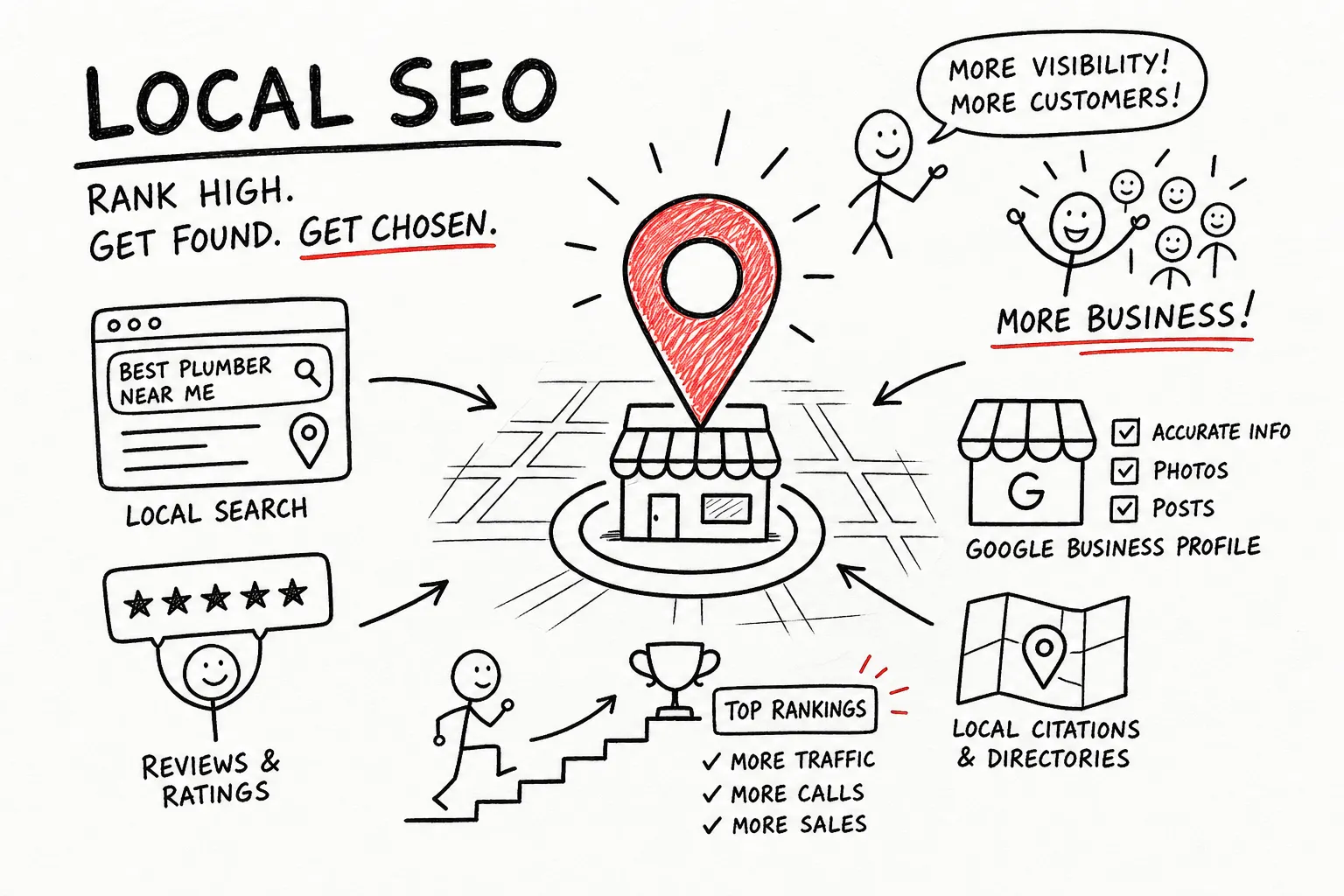
GBP carries approximately 32% of local pack ranking influence, according to Whitespark’s 2026 Local Search Ranking Factors report, making it the single most impactful place to start your local SEO effort. Two strategies build directly on each other here: completing your profile fully and keeping it consistently active.
1. Complete every section of your profile with precision
Claim and verify your profile first; verification should be your earliest priority because it prevents conflicting edits and unlocks full profile features. Set your primary category to the most accurate description of your core business, because category selection is the strongest relevance signal in your entire profile. Fill in every available field: hours, holiday hours, service areas, website, phone number, and business description. Add individual services with clear, keyword-relevant names and apply every attribute that genuinely applies to your business. A fully completed profile tells Google this is a legitimate, well-maintained operation worth showing to searchers.
2. Post regularly and refresh your photos on a schedule
Keeping your Google Business Profile active with consistent posts and fresh photos signals relevance in ways that sporadic updates simply don’t replicate. Aim to add new photos at least bi-weekly, starting with at least 12 high-quality real-world images that cover your exterior, interior, team, and services. Each post should include a clear call to action and a relevant image tied to your service or a current offer. A steady posting cadence, even if it’s only twice a month, tends to outperform businesses that update their profile only when they remember to, because recency is a factor Google weighs when evaluating profile engagement.
NAP Consistency and Citation Building That Strengthens Local Authority
NAP (Name, Address, Phone) consistency is a trust signal that Google uses to confirm your business is real and located where you say it is. Even small inconsistencies across high-authority citations can hurt trust and may reduce local authority; audit and fix the top listings first.
3. Audit and fix NAP consistency before building anything new
Run a full NAP audit before adding a single new listing. Compare your business name, address format, and phone number across all existing citations, looking for variations such as “St.” vs. “Street” or inconsistent suite formatting. Fix your top-authority listings first: Google Business Profile, Apple Maps, Bing Places, Facebook, and Yelp. Keep a master spreadsheet with every listing URL, login credentials, and current NAP so you can update them quickly when anything changes. Correcting the top ten inconsistent citations is a reliable first step toward improving local pack rankings, it’s a practitioner rule of thumb worth following before you invest in building new directory presence.
4. Build citations in the right directories for your Canadian market
Once your existing listings are clean, start building new ones strategically. For Canadian businesses, Tier 1 is Google Business Profile, Apple Business Connect, Bing Places, and Facebook. Tier 2 includes Yelp, Foursquare, the Better Business Bureau, YellowPages.ca, and Canada411, as well as niche directories relevant to your industry, such as Houzz or BuildDirect for home services, RateMDs for healthcare providers, or legal directories for professionals. Niche directories consistently carry more weight than generic long-tail ones, so direct your energy there before chasing every directory you can find online.
Local SEO Tips: Keyword Targeting and Location Pages That Rank for “Near Me” Searches
Local keyword research focuses on service-plus-city combinations and high-intent phrases rather than broad, generic terms. For example, “plumber in Mississauga” targets a ready-to-hire searcher far more effectively than “plumber” alone. Those keywords need to live on properly structured location pages, not just your homepage, to support both map pack and local organic rankings.
5. How to find and map local keywords to the right pages
Start by researching service-plus-city-and-neighbourhood combinations for every area you serve. Use Google Search Console to see what local queries are already driving impressions, and check Google’s autocomplete to understand how customers phrase their searches in your market. Map your keywords to specific pages: your homepage covers your primary market, while dedicated location pages handle additional cities or service areas. Weave location terms naturally into H1 tags, title tags, meta descriptions, and body copy rather than stuffing them at the end of a paragraph where they read as forced.
6. Build location pages that prove you’re a real local business
Each location page needs genuinely unique content, not a template with a swapped city name and nothing else. Include that location’s NAP details and service-area descriptions. Add local testimonials, team photos, and community context that someone from that area would actually recognize. Use a consistent URL structure like /locations/city-name/ and write an H1 that combines your service and city. Embed a map and link to the page from your main navigation. These pages should function as a local business hub, giving both Google and prospective customers clear proof that you genuinely serve that area.
Best SEO Strategies for Local Businesses: Reviews and Reputation
Reviews influence local pack rankings through quantity, recency, and sentiment, and they directly affect whether a searcher calls you or scrolls past your listing. In competitive Canadian markets, businesses in categories like dental or plumbing often need 75 to 200 reviews or more to hold a top-three map pack position, based on practitioner benchmarks from 2026 local search research. Beyond rankings, businesses with stronger ratings consistently get more clicks than lower-rated competitors in the same results.
7. Build a system for generating reviews consistently
Ask for a review at the exact moment of peak satisfaction: right after a completed service or purchase, before the customer has had a chance to move on. Send a direct SMS or email with a one-click review link, or use a QR code for in-person triggers at checkout or on service completion receipts. Train your staff to make the request naturally as part of the service wrap-up conversation. The goal is a steady flow of new reviews over time, not a single spike. Consistent review velocity signals an active, credible business to Google and keeps your profile looking current to anyone researching you.
8. Respond to every review, positive and negative
Responding to positive reviews reinforces trust and shows genuine engagement with your customers. Responding to negative reviews professionally often impresses prospective customers more than a perfect rating does, because it demonstrates accountability and follow-through. Keep your responses timely, specific, and genuine; avoid copying and pasting the same templated reply across every single review. Response quality and consistency correlate with better conversion outcomes, so treat this as an ongoing part of your reputation management rather than an occasional task.
Schema Markup and Local Backlinks That Build Real Authority
Two strategies are frequently skipped by small businesses, which is exactly why implementing them gives you a real edge over competitors who skip this step. LocalBusiness schema helps Google understand and match your on-page details with your GBP and other signals, while local backlinks build the prominence that separates strong organic rankings from mediocre ones.
9. Add LocalBusiness schema to every location page
Use JSON-LD format and include your business name, address, phone, hours, geo coordinates, and service area in a separate schema block on each location page. Don’t combine all your locations into one block sitting on the homepage. Consistent, accurate schema helps Google match your on-page signals with your Google Business Profile, reinforcing the trust you’ve already built across the rest of your local search optimization effort. Use Google’s Rich Results Test to confirm your implementation is clean before moving on to the next priority.
10. Earn local backlinks through community and partner connections
Local press coverage, community sponsorships, chamber of commerce memberships, local business associations, and supplier or partner websites are all reliable sources of genuine local backlinks. Avoid link schemes entirely; the goal is links that are genuinely relevant to your market and service area, not shortcuts that put your domain at risk. Even a small number of strong local links can meaningfully boost your local organic rankings, especially in mid-sized Canadian markets where competitors haven’t invested in link building at all.
Measuring What’s Working and When to Get Expert Help
Tracking your local SEO performance turns guesswork into decisions. Without regular monitoring, you won’t know which strategies are already delivering or where your biggest opportunity is sitting untouched.
Track your local performance with the right metrics
Review your GBP Insights weekly and monitor views, direction requests, calls, and website clicks as your core engagement indicators. Use Google Search Console to track local keyword impressions and click trends over time, looking for movement on your priority service-plus-city queries. Check your review count, average rating, and response rate monthly to keep your reputation signals healthy. Run a rank tracker for your primary keyword combinations to see where you sit in the local pack, and adjust your GBP categories, post content, or location page copy based on what the data actually shows.
Why ongoing local SEO management compounds your results
Local SEO isn’t a one-time setup. Google’s algorithm updates, competitor moves, and shifting review velocity all require ongoing attention to sustain and improve your rankings over time. At DE SEO Consulting, we manage these strategies continuously for business owners who don’t have the bandwidth to monitor rankings, fix citation inconsistencies, and generate reviews on top of running their operation every day. A dedicated local SEO specialist brings both the expertise to prioritize the right tactics and the consistency to build results that grow month after month.
Put These Strategies to Work Starting Today
Local search visibility comes down to consistent execution across two interconnected areas: foundational signals (Google Business Profile, NAP consistency, citations, and schema) and engagement signals (location pages, reviews, and local backlinks). Businesses that work through this list methodically see measurable improvement in local rankings and the quality of leads coming through their door.
These are the best SEO strategies for local businesses in 2026, and what separates the businesses appearing at the top of the local pack from the ones hoping their competitor doesn’t answer the phone first. Start with your Google Business Profile today, get your NAP consistent across every directory, and build from there.
If you want a partner to manage the full strategy end to end, DE SEO Consulting is ready to do exactly that. We handle the ongoing implementation, monitoring, and adaptation so you can stay focused on serving your customers and growing your business.