7 Ways AI Is Changing SEO Strategies for Business Growth
Discover how AI improves SEO strategies for businesses: from keyword research to on-page optimization. Learn what works, what doesn’t, and how to use it right.
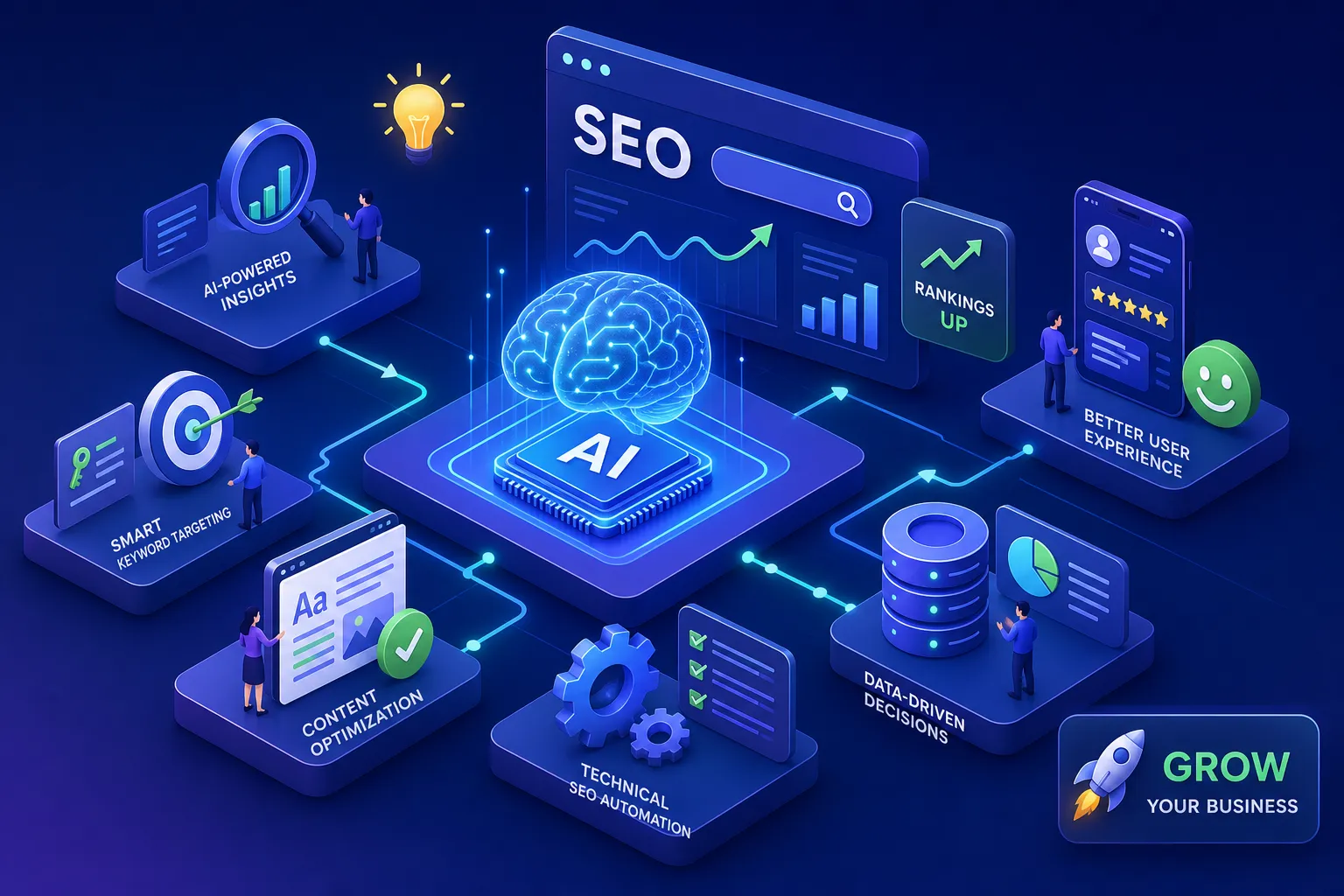
If you’ve been wondering how AI improves SEO strategies for businesses, the short answer is: it makes research faster, on-page decisions sharper, and technical monitoring more scalable. But the longer answer matters more. AI tools have moved well past novelty, and if you’re running a business trying to compete in organic search, the question isn’t whether AI belongs in your SEO workflow. It’s which applications actually move the needle and which ones just add noise. The gap between those two things is wider than most vendors will admit.
At DE SEO Consulting, we’ve integrated AI-assisted research into a white-hat SEO framework for clients across multiple industries. The honest result: AI-driven SEO strategies work when the human strategy layer keeps them from becoming a liability. Here are seven concrete ways AI is reshaping organic search, plus a clear-eyed look at where it still falls short.
1. AI keyword research goes deeper than any spreadsheet can
Traditional keyword research meant pulling volume data from a tool, sorting by difficulty, and making educated guesses about which terms were worth targeting. AI for SEO changes the process entirely. It processes massive datasets in seconds, spots patterns across thousands of queries, and surfaces opportunities that manual research consistently misses.
How AI uncovers long-tail opportunities faster
Long-tail keywords convert better because they reflect specific intent. A searcher typing “emergency plumber Vancouver Island Sunday night” is not browsing. AI keyword research tools find these phrases at scale by analyzing SERP patterns, related queries, and user behaviour signals rather than just search volume. Tools like Semrush and Ahrefs now apply machine learning to surface high-conversion phrases before a human researcher would even think to look for them.
Clustering keywords into content topics that build authority
AI groups related keywords by intent and semantic relationship, which means you get a content strategy, not just a keyword list. Instead of chasing isolated terms, you build content clusters that signal topical authority to search engines. Platforms like Keyword Insights and SE Ranking automate this clustering, turning a raw export of 500 keywords into a structured content map you can actually execute against.
2. Content gap analysis: finding what your competitors missed
AI-powered gap analysis compares your existing content against top-ranking pages and competitor strategies to identify subtopics, questions, and angles your site hasn’t addressed. The system looks at what’s ranking, what appears in People Also Ask boxes, which entities are referenced, and where your coverage is thin; no guesswork involved.
Comparing your site against what’s already ranking
Automated SEO tools audit the top-ranking competitor pages for your target queries and identify which subtopics and related questions your content is missing. The output isn’t a vague suggestion to “write more content.” It’s a concrete list of the specific angles your pages need to cover to compete. For a local service business, this might reveal that competitors are answering five common questions your service page ignores entirely.
Turning gaps into a smarter content roadmap
Gap findings give you a prioritization framework. Rather than publishing broadly without a clear angle, you can identify which pages have the highest potential to compete based on real competitive data. That’s the difference between a reactive content calendar and a deliberate organic growth strategy.
3. How does AI improve SEO strategies for businesses through intent matching?
Search intent is the most critical factor in whether a page ranks and converts. Machine learning classifies queries as informational, transactional, navigational, or commercial far more accurately than manual review, by analyzing SERP patterns to determine what Google considers the correct match for a given query.
Why intent classification beats volume as a targeting signal
Ranking for a high-volume query with the wrong intent produces a high bounce rate, low dwell time, and zero conversions. A moderate-volume query that perfectly matches your offer will outperform it every time. AI helps you identify which is which before you invest time building the page. Getting this wrong wastes content budget and can hurt ranking signals across your entire domain.
How AI uses SERP signals to read what Google expects
AI tools analyze top-ranking pages for a query to determine whether Google favours long-form guides, quick answers, product pages, or comparison articles. That signal tells you what format, depth, and call-to-action placement your content needs before you write a single word. It’s a structural decision, not a creative one, and machine learning makes it faster and more accurate than manual SERP review.
4. On-page and semantic optimization that actually scales
AI content optimization addresses multiple layers of on-page performance simultaneously. Meta tag optimization, semantic content expansion, and AI-assisted internal linking each close a different gap, and together they move pages from “good enough” to competing for top positions on the SERP. The goal isn’t to automate everything; it’s to make the decisions that were previously too time-consuming to do well at scale.
Smarter meta tags and schema markup from AI suggestions
AI generates and evaluates multiple title tag and meta description variations scored for CTR appeal, character limits, and keyword placement. It also recommends appropriate schema types for each page, FAQ, Product, Article, LocalBusiness, and others, then flags missing structured data fields. This is especially valuable for businesses with large sites where manually auditing schema across hundreds of pages isn’t practical.
Semantic content expansion beyond keyword repetition
AI uses natural language processing to identify related concepts, entities, and unanswered questions a page should address to be considered comprehensive by search engines. This replaces keyword stuffing with genuine topical depth. WordLift reported 80% organic traffic growth and 700+ keywords on Google’s first page through a semantic AI implementation (WordLift case study, 2023). The underlying principle is consistent: covering a topic more completely outperforms repeating a target keyword more often. Semantic search optimization isn’t about density; it’s about completeness.
5. Technical SEO automation: the tasks AI handles better than humans
AI-powered crawling and monitoring tools detect issues across thousands of pages simultaneously. They cross-reference server logs to identify crawl budget waste, then translate raw crawl data into prioritized action items rather than handing a developer a spreadsheet of 2,000 errors with no context. That last part is what makes the difference in practice.
Site audits, crawl monitoring, and log-file analysis at scale
AI crawlers identify broken links, redirect chains, index coverage issues, and crawl budget inefficiencies. Log-file analysis reveals which pages search bots are ignoring and why, information you simply can’t get from a standard audit tool. The practical workflow: run a scheduled crawl, review an AI-summarized comparison against the previous baseline, assess the drafted fix recommendations, then approve before deployment. RankSense documented a 35% reduction in crawl errors using this kind of automated technical monitoring (RankSense, 2023).
Automated schema generation and validation
AI generates JSON-LD markup from existing page content, validates current schema against requirements, and flags missing fields. For a business running a large service site or e-commerce catalogue, this reduces the manual effort required to implement and maintain structured data across the entire site. One honest caveat: fully autonomous fixes on high-risk pages still need human review before going live. The AI flags the problem and drafts the fix. A person approves it.
6. What AI does well in SEO, and where it still needs a human
AI excels at research, pattern recognition, optimization suggestions, and automating repetitive technical tasks. It does not replace genuine expertise, first-hand experience, brand voice, or nuanced editorial judgment. That distinction matters more now than it did two years ago, because Google’s quality systems are increasingly good at identifying content that is technically optimized but genuinely thin.
The AI applications that deliver real, measurable results
The documented case studies are worth knowing. According to Writesonic’s published results (2023), AI-assisted content work produced a 65% increase in organic traffic over three months, with target keywords moving from page 3 to page 1. SearchPilot’s structured on-page testing drove a 26% increase in traffic (SearchPilot, 2022). BrightEdge clients have reported a 30% increase in search revenue alongside 74% year-over-year revenue growth (BrightEdge, 2023). Clearscope users reported a 67% increase in organic search traffic (Clearscope, 2023). These results came from generative AI for SEO applied within a disciplined strategy, not from AI running unsupervised.
The E-E-A-T guardrails every business needs before publishing
AI content published without proper review risks algorithmic penalties and trust erosion, regardless of how well-optimized it looks. The non-negotiables are subject-matter expert review, original insight and first-hand experience signals, fact-checking of every claim, clear authorship and credentials, source citations, and regular content updates. Google’s Search Essentials treat content produced primarily for ranking manipulation as a spam policy violation, and enforcement has grown more consistent. Skipping these steps doesn’t save time; it creates cleanup work later.
Why the human strategy layer still determines the outcome
AI is a powerful research and efficiency tool. But the strategic decisions- what content to create, which audience to serve, which intent to match, which gaps matter most to your business- still require experienced human judgment. This is where working with a strategic partner like DE SEO Consulting changes the outcome. The tools surface the data. The strategy determines what to do with it. Businesses that treat AI as a replacement for SEO expertise tend to produce a lot of content that ranks for nothing and converts nobody. Adding a concrete example: a business that automates blog output without intent alignment often sees strong impressions but low click-through rates because the content never matches what searchers actually want.
Using AI-driven SEO strategies as a growth accelerator, not a shortcut
The seven applications covered here represent a genuine shift in how competitive SEO gets done: faster AI keyword research, smarter content gap analysis, intent classification at scale, semantic search optimization, automated technical monitoring, schema generation, and a clear-eyed approach to where AI still needs human direction. That’s not a promise of overnight rankings. It’s a more efficient path to sustainable organic growth.
Understanding how AI improve SEO strategies for businesses comes down to this: AI raises the quality and speed of research, sharpens on-page decisions, and scales technical monitoring in ways that weren’t practical before. But it only delivers those results within a disciplined, white-hat SEO framework. The businesses that will see the strongest long-term gains from AI-assisted SEO are the ones using it to sharpen their strategy, not replace it.
If you want to implement these methods without the trial-and-error of figuring out which tools fit your specific situation, that’s the work DE SEO Consulting does with clients. We combine AI-assisted research with the human strategic layer that makes organic growth stick. Reach out to discuss what a structured approach looks like for your business.